![What Happened To [Archive]](https://storage.ghost.io/c/0a/d8/0ad8538b-4bb8-4bb6-8566-c2b76c73744b/content/images/2026/03/whathappenedto---1--1--6-.png)
What Happened To: AIM — Case File 002
AOL Instant Messenger invented the social internet for an entire generation. It ran for twenty years. When Verizon finally shut it down in December 2017, the announcement came in a blog post that nobody read.
Filed by: The What Happened To Archivist | Status: Closed — December 15, 2017 | Tags: AIM, AOL, instant messaging, Verizon, 90s internet, social media origins
At its peak, AIM handled more than 1.5 billion instant messages per day. It taught a generation how to communicate in text. Every messaging app you use today is built on what it invented. It never got a funeral.
The Program Nobody Was Supposed to Build
It's 1996. AOL is the internet, for most Americans who have the internet at all. You access it through a CD that came in the mail — there were so many of those CDs that in 1998 AOL was spending half its marketing budget on them. The service costs money, it's slow, and it is a walled garden: what's inside is AOL, and what's outside isn't for you.
A small team of engineers at AOL — Barry Appelman, Eric Bosco, and Jerry Harris — wanted to build something different. An instant messaging system, open and free, that anyone could use whether or not they paid for AOL. They had no official sanction to build it. AOL's entire business model was built on charging for access, and a free standalone product was not something the company's executives were inclined to approve.
So they didn't ask. Appelman made an unofficial request to the head of AOL's data centers: were there any servers available? An employee was about to ship some Hewlett-Packard servers back to the manufacturer and agreed to quietly misplace them for a few days. That was enough.
AIM launched in May 1997 — not with a press release, not with a product announcement, but as an unheralded download buried on AOL's servers. Its first night online drew 900 simultaneous users. Not the five million Appelman had dreamed of, but far more than anyone expected. AOL's executives were surprised, and not pleasantly. The service was free. This was not the plan.
They were right. Management wasn't.
The Away Message Was a Status Update Before Anyone Knew What That Was
To understand what AIM actually was, you have to understand what it felt like to sign on.
The dial-up modem sound. The connection negotiating, squealing, achieving. The AIM window appearing, the buddy list populating — names going green, one by one, as your friends came online. And then the door sound: a wooden creak that meant someone had entered your world. You would learn to identify whose arrival sound was whose, the way you'd recognize a knock at the door.
The away message was, in retrospect, a social media feed that predated social media by a decade. You weren't just letting people know you weren't there — you were performing yourself. Away messages held your favourite song lyrics, inside jokes, declarations of teenage feeling, deliberate obscurity calibrated to be decoded by exactly one person. They changed hourly. They were curated with great care by people who would have sworn they didn't care at all.
If you had a crush on someone, you watched their away message the way people now watch Instagram stories. You read the lyric they'd chosen and tried to understand what it meant, whether it was for you, whether the timing was meaningful. The away message was the ancestor of the tweet, the status update, the story — not metaphorically, but technically. When Facebook introduced status updates, it was solving the same problem AIM had already solved.
At its peak in the early 2000s, AIM reported more than 100 million registered users and over 53 million active users. It was handling more than 1.5 billion instant messages per day. It was the way teenagers talked to each other, full stop. Confessions of love, breakups, homework help, plans for the weekend, cruelty, friendship, the entire emotional vocabulary of adolescence — it ran through AIM.
The screen name you chose mattered. It was your identity in a new medium that had no established rules for identity. Parents didn't understand it, which gave it the quality of a secret world. You had a name that wasn't your name, a door sound that was yours, an away message that said exactly as much as you wanted to say to everyone without saying it to anyone in particular. It was a new form of being social that nobody had a word for yet because it was the first time it had existed.
The Features That Everyone Copied
AIM invented things that are now so fundamental to digital communication that it's difficult to imagine them being invented at all — they seem like they must have always existed.
The Buddy List. Presence indicators — the simple fact of knowing whether someone is online or not — was an AIM invention that every subsequent messaging platform, social network, and workplace tool has replicated. Slack's green dot is an AIM feature. Discord's status system is an AIM feature. The "active now" indicator on Instagram is an AIM feature.
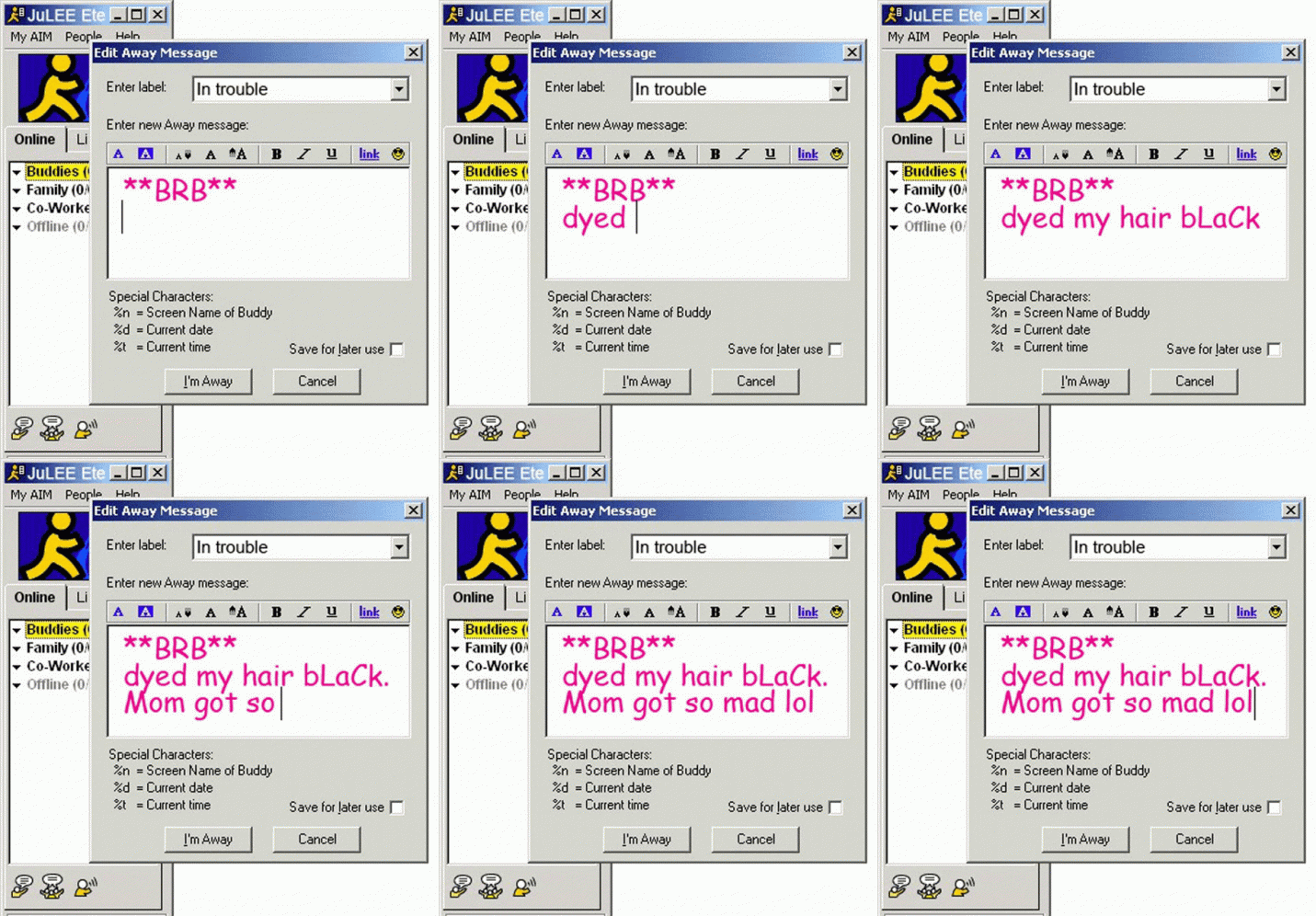
The typing indicator — the notification that the other person is composing a message — was an AIM original. It changed the rhythm of digital conversation, creating a kind of real-time shared suspense. The three dots on iMessage are a direct descendant.
The concept of a distinct, chosen online identity — a screen name that was yours and meant something, rather than a real name or an email address — was how AIM organized social life online. The idea that your online persona could be creative, aspirational, or ironic was something AIM users understood intuitively before anyone had theorized it.
Emoticons reached mainstream use through AIM. The grammar of digital emotion — :) :( :/ ;) — became a common language because tens of millions of teenagers were using it every day to fill in the tonal gaps that text couldn't carry. That grammar eventually became the emoji keyboard that ships on every smartphone on earth.
Zuckerberg later posted a eulogy crediting AIM as "a defining part of growing up" and acknowledging that Facebook Messenger's core features descended directly from it. The patent for AOL's Buddy List is now held by Meta.
The engineers who built AIM — unofficially, on servers that were supposed to be shipped back to the manufacturer — built the architecture of how the modern internet communicates.
How AOL Spent Twenty Years Losing a Won Game
AOL acquired ICQ, AIM's main early rival, in 1998 for $287 million, giving it effective dominance over instant messaging in North America. It had the user base, the technology, and the infrastructure. It was early. It was right.
And then it spent two decades getting everything wrong.
The original sin was treating AIM as a nuisance. The engineers who built it were never given the resources, the headcount, or the executive support to develop it properly. AIM's team reached a maximum of about 100 people — tiny for a product handling 1.5 billion messages a day. The people who ran AOL were, throughout most of its history, in the business of charging people for internet access. A free product that didn't fit that model was always going to be treated as a distraction.
AOL had a chance to build mobile messaging before smartphones made it the default platform for human communication. It didn't.
When Facebook launched its chat function in 2008, when Google launched GChat, when SMS became free with unlimited plans — AIM had no answer for any of it. In March 2012, AOL laid off most of AIM's development staff while leaving the service technically running, which is perhaps the most efficient summary of the company's approach. They kept the lights on and stopped paying for the electricity.
By 2011, AIM's market share had collapsed to under one percent. In 2015, AOL was sold to Verizon for $4.4 billion — for context, WhatsApp had sold to Facebook the year prior for more than $19 billion. Verizon then combined AOL and Yahoo into a subsidiary called Oath, and on October 6, 2017, announced that AIM would shut down on December 15th.
The announcement ran on the AIM help page and in a press release that nobody particularly ran to cover. The technology press wrote brief retrospectives. Twitter ran a few hours of nostalgic screen names. Then it was gone.
December 15, 2017
A software engineer named Justin Tan, aware that the end was coming, wrote a script to send messages at one-second intervals as AIM's official discontinuation time — 12:00 AM EST — approached. He wanted to send the last message ever transmitted on AIM. He mostly wanted to be there when the lights went out.
The service went offline. The door creaked shut for the last time.
There was no migration plan. There were no data exports. There was no way to retrieve the conversation history you'd accumulated over twenty years — the confessions, the breakups, the jokes, the arguments, the late-night conversations that felt, at the time, like the most important words you'd ever written. They were gone with the service.
Verizon's statement on the shutdown said: "AIM tapped into new digital technologies and ignited a cultural shift, but the way in which we communicate with each other has profoundly changed. We're more excited than ever to continue building the next generation of iconic brands and life-changing products for users around the world."
Nobody has been able to identify what those next-generation iconic brands were.
What Survived, What Didn't
A non-profit development team called Wildman Productions runs AIM Phoenix, a server that allows older versions of AIM to connect. It is not the same thing. The conversations that lived on AOL's servers are gone. The away messages, the chat logs, the buddy lists — twenty years of a generation's digital social life — were not archived, were not saved, and cannot be recovered.
What survived is structural. Every major messaging platform in use today is built on AIM's architecture: presence indicators, typing notifications, away states, the buddy list model. Slack, Discord, iMessage, Facebook Messenger, WhatsApp — all of them are elaborations on what three engineers built on borrowed servers in 1996.
The culture survived too, in the way that foundational things survive — so thoroughly absorbed into what came after that it's become invisible. The abbreviations AIM popularised — BRB, LOL, GTG, AFK, TTYL — are now the basic vocabulary of digital communication. The idea that you could be a person online, that your online identity could be expressive and distinct and yours, was something AIM taught an entire generation before Facebook made it a business.
What didn't survive is the feeling. The specific texture of a medium where you were present to people you knew, in real time, without performance, without an audience, without an algorithm deciding whether what you said was worth amplifying. You and your friends and a door sound and an away message and the cursor blinking while you waited for them to finish typing.
That's gone. Nothing that came after has replaced it, exactly. Everything that came after made it bigger and faster and louder and more public, but not the same.
Case File Summary
Subject: AOL Instant Messenger (AIM)
Active: May 1997 – December 15, 2017
Built by: Barry Appelman, Eric Bosco, and Jerry Harris — as an unauthorised internal project at AOL
Peak users: 100 million registered, 53 million active — circa 2001–2002 — source
Peak volume: 1.5 billion instant messages per day — source
Market share at peak: 52% of all instant messaging in North America — source Sold with: AOL to Verizon — 2015 — $4.4 billion
Final owner: Oath Inc. (Verizon's AOL/Yahoo subsidiary)
Users at shutdown: Approximately 500,000 active — source
Cause of closure: Cost of maintaining OSCAR messaging protocol outweighed value to Verizon — no migration, no archive, no replacement — source
What survived: AIM Phoenix (fan-run server); structural legacy in every modern messaging platform; Meta holds the Buddy List patent — source
Status: Closed
What was your screen name? The case file is open. Contact link is in the footer.
What Happened To Archive publishes investigations into the disappeared corners of 90s and early 2000s internet culture. Subscribe to receive new case files when they're filed.